

 Filipino


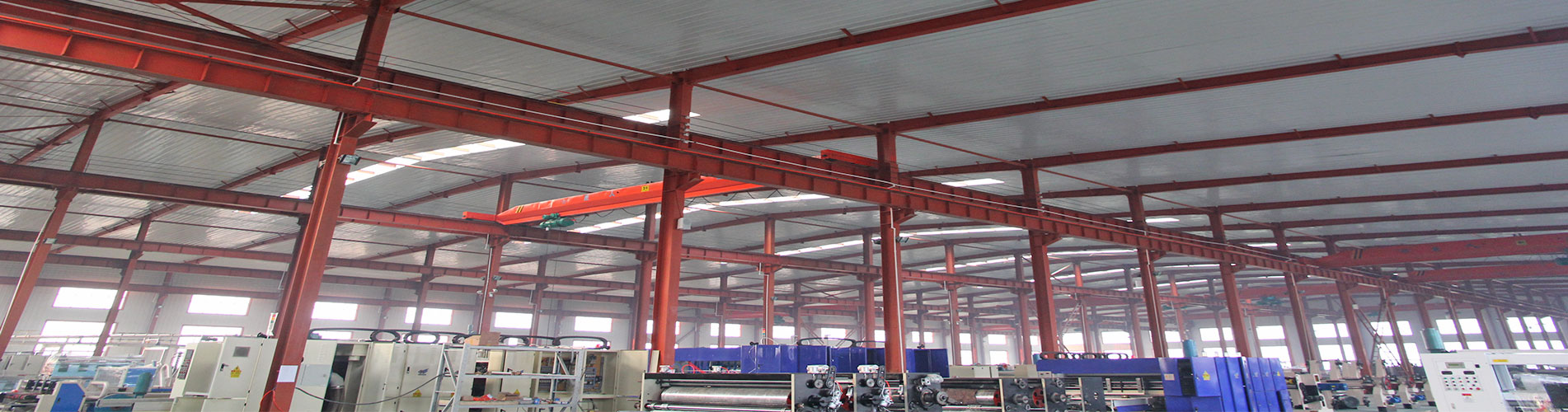

The key advantages of using steel structures for stadiums and gymnasiums
1. Large Spans with Column-Free Space
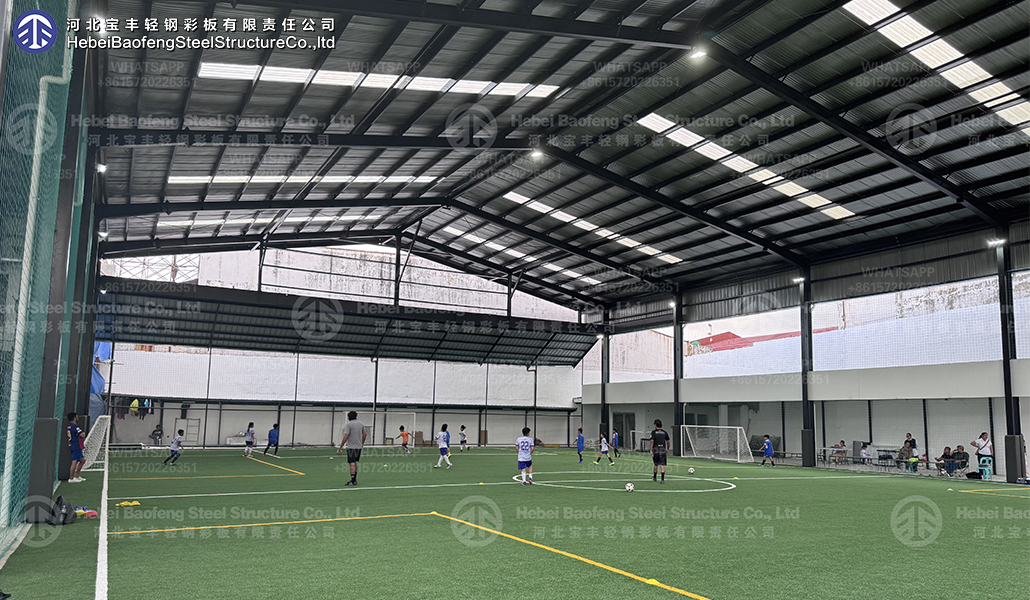
Stadiums require unobstructed sightlines for spectators. Steel’s high strength-to-weight ratio makes it possible to achieve very large spans—often dozens or even over a hundred meters—without the need for interior support columns. This creates a completely open interior, allowing flexible seating arrangements and clear views for all spectators.
2. Lightweight, Reducing Foundation Costs
Although steel is dense, its high strength allows for smaller, lighter components. The overall self-weight of a steel structure is much lower than that of a concrete structure, which significantly reduces the load on the foundation. This lowers foundation engineering costs and is especially advantageous in areas with soft soil.
3. Fast Construction and Shorter Timelines
Steel components are prefabricated in factories under controlled conditions and then delivered to the site for assembly. The on-site work is similar to “building with blocks,” with minimal dependence on weather. This greatly shortens the construction period—a major advantage for venues that must be completed on a tight schedule for sporting events.
4. Design Flexibility and Strong Architectural Expression
Steel can be bent and fabricated into a wide variety of curved shapes, making it possible to realize complex spatial surfaces. Many iconic stadiums—such as the Bird’s Nest (Beijing National Stadium)—rely on the expressive capabilities of steel structures to create visually striking landmark buildings.
5. Excellent Seismic Performance
Steel has good ductility and toughness. Under seismic forces, it can absorb energy through deformation without sudden brittle failure or collapse. In addition, the light self-weight reduces the inertial forces during an earthquake, further improving seismic safety.
6. High Space Efficiency
Steel members have much smaller cross-sections than concrete members. Within the same building footprint, this provides more usable interior space. The cavities and joints in steel structures also make it convenient to route mechanical and electrical pipelines, reducing the ceiling space required.
7. Demountable and Recyclable
Steel is 100% recyclable, and demolition does not generate large amounts of construction waste. For temporary or adaptable venues, steel components can even be disassembled and reassembled at another location, supporting sustainable and green building practices.
8. Easy to Modify and Expand
The connections in steel structures make future reinforcement, adding floors, or altering interior layouts relatively straightforward. This adaptability allows a stadium to evolve with changing functional needs—for example, switching between competition mode and concert mode.
In summary, the core advantages of steel structures for stadiums are: large column-free spaces, light weight, fast construction, design flexibility, strong seismic performance, high space efficiency, recyclability, and ease of modification. These qualities make steel one of the preferred structural choices for modern stadiums and gymnasiums.
Mga kategorya
pinakabagong blog
Mga tag


Para sa Mga katanungan tungkol sa aming mga produkto o pricelist, mangyaring mag-iwan sa amin at kami ay nakikipag-ugnay sa loob ng 24 oras.
© Copyright: 2026 Hebei Baofeng Steel Structure CO.,LTD Lahat ng Karapatan ay Nakalaan.

IPv6 suportado ng network


 +8615720226351